Monday, November 29, 2010

Reading Response 8—The future lives with technology

If you want a golden rule that will fit everybody, this is it: Have nothing in your houses that you do not know to be useful, or believe to be beautiful.
                                                                                       ----Norman, P227

The time has come to concentrate on making the world a Human-tech Revolution could have a profound impact on modern times. Technology that has a close affinity with human nature is capable of creating tremendous social changes, on a global scale. It could radically improve our lives and those of our children and grandchildren.
                                                                                        ----Vicente, P305

Finishing reading the last chapters of both Norman’s and Vicente’s book, I could not help imaging our future lives filled with emotional design and a Human-tech revolution. What will our lives look like? Perhaps, one day, all of the following imaginations will be turned into reality. We don’t need to be upset for the errors or accidents caused by the inconsiderate ill-designs, as human-tech make an optimization for human beings. We don’t need to worry about the traffic jams in a rush hour, as all of us drive our own air vehicles, something like the combination of a mini-couper and a helicopter. We don’t have to take time for boring chores, as our robot housekeepers are responsible for them without our reminders, so on and so forth.

You might tease me that the dream is too big to be true, but, can those people living in 1970s imagine the development of computer technology, such as internet, dramatically changes the world as we are currently experiencing? No matter which technology of industry that was talked about in Norman’s and Vicent’s book, it is the design matters. The purpose for any design or technology is to have better lives for human beings. We are all designers, every of us can make a difference for the world, not only those engineers who grasp advanced technology on software and hardware can design and produce objects, but we, as a ordinary custom, can make each ready-made object personalization and customization.

Certainly, as for the development of a certain technology and its application, to a large extent, it is the manufacturers, organizations, governments and a country to make the final decision. However, as citizens, we absolutely have rights to call for the well-design filled with consideration of human-tech, as “we may not have any control over the design of the many objects we purchase, we do control which we select and how, where, and when they are to be used (Norman, P224). ” In other words, our decisions have a great impact on the marketing, which greatly affect designer’s ideas and behaviours. In return, their designs fit us and benefit human beings.

We can try to do our best to make a difference for our future lives. Below is a video clip for the future lives in 2050. It visions nearly all the aspect of our future lives. That’s so cool. With well-designed technology, it is not just a dream!  

Monday, November 22, 2010

Reading Response 7—Emotional Machines

Intrigued by the title of the chapter--“Emotional machines”, I cannot help starting with the journey of imagination that what on earth was those machines with emotions that are only described for human-beings. Guided by some fancy ideas, I was led by these main questions explicitly demonstrated by Norman.
  • Why do robots have to have emotions?
  • What emotions will a robot need to have?
  • How can robots show their emotions and then interactive with us?
According to Norman, machines, specifically Robots, should indeed both have and display emotions so that we human-beings can better interact with them. In addition, they can continuously deal with more complex and sophisticate situations and works when there is no assistance from people. Like human-beings, facial expressions and body motions are indispensable parts of robots to show their pleasure, anger, surprise, frustration, etc., although it is still a difficulty for nowadays technology to allow them to display full facial emotions. Interestingly, however, we have already had Eliza, Kismet, and Sony robot dogs, which are computer-driven machines or robots with certain emotions. They benefit us a lot and enrich our lives.   

And, another questions was also raised by Norman which need to be further explored and examined in the future research: How do robots detect human-beings’ emotions and how to determine the most appropriate way of responding? In other words, while we struggle to determine how to make machines respond appropriately to signs of emotions, people aren’t particularly good at it either, as it is so common for people to be insensitive to emotional states of others, even to misunderstand their own friends. Back to me, I sometimes misunderstood my friends and could not figure it out caused by culture issues. Therefore, it is a huge challenge to allow robots to respond us properly and perfect. But, I still dream big and I am definitely optimistic to the future development of science and technology.

Personally, Norman’s robots recall me of Wall-E, an adorable robot as the leading character in Disney movie “Wall-E” of 2008. He is dutiful, optimistic, compassionate and righteous. He not only has a feeling with a seedling plant, but falls in love with another female robot, which usually happened in human-beings. Obviously, the filmmaker applied an image of robot to represent human-beings as well as to express our dreams. From Wall-E, we saw ourselves. From this movie, I could also see that emotions make everything possible. With high-tech development, who can deny that there will be a real Wall-E with us in future?

I am not a fan of science fiction, but one day, I still wish I had my own robot, somewhat akin to man Friday. She could be a good housekeeper in my house, meanwhile, she could emotionally interact with me and provide me with assistance like a buddy. Frankly, I don’t like the look of Kismet at all, which is showed in Figure 6.6, p192. It is not cute and lovely, to some extent, a bit ugly. I prefer my robot looks like a fancy doll, at least looks like Wall-E—Oh, sorry, it is my own emotional interpretation.


Monday, November 15, 2010

Reading Response 6--Management Matters

Designing an effective new organizational structure to enable an entire safety-critical industry to learn from experience, foresee and prevent accidents and prevent needless deaths was a huge challenge.
                                                      -------Vicente Chapter 7, P 200
Regarding technology design, before I read this chapter, in my mind, I had no very clear idea that “The design of technology and the management of technology aren’t two separate things (p 190). ” I did not realize that they correlate each other as Vicente elaborated in this chapter.

Enlightened by the true stories he showed to us, when I recalled my Olympic experience to respond Vicente’s opinion, what I could say and respond in my mind is Yes! Yes! And Yes! As a supervisor, I once worked at the Arrival and Departures Desk in the Olympic village during the Games time. Apart from supervising the daily issues running by this desk, one of my main responsibilities was to create daily operational reports for the direct manager. Even though there was no unexpected incident, I was still required to create the daily report as usual, including any suggestions, details of solved problems, to make sure information was shared smoothly and everything was on the right track. I indeed remembered how we encountered and solved an urgent issue that a sensitive delegation arriving in Beijing international airport at midnight without providing their final arrival information, so that there were no arranged vehicles by us to deliver them to the Olympic village, which made them detained in the airport for nearly two hours. Unfortunately, the chef of Mission was annoyed by it and complained it to their country’s Embassy in China. Although it was not concerned with the fatal accidents like medical errors or aviation failures mentioned by Vicente, it was something to do with the reputation of this kind of international event, as diplomacy is no small matter. This incident was absolutely reported in the daily report and was well-known widespread in the inner functional departments in Olympic village. “The goal is to find out what’s to blame, not who’s to blame (P 201). ” It did give us a lesson to pay attention to develop our plans with contingencies as well as provide us valuable experience from it. How helpful and useful the daily report is! And how great it is to make a reasonable and usable management design. We could not imagine how many of these similar incidents would occur again in the village if we did not share this lesson with all, and namely, we were not able to count how many of these similar or worse incidents were avoided by this important sharing.  

As Vicente claimed that all the well-tailored design might go down the drain if organizational considerations aren’t also dealt with effectively, organizational decisions, such as information flow, allocation of functions, reward structures and staffing decisions can have a significant impact, not just on a single individual or a single team of individuals, but on all of the individuals in an organization (P 227).

Designing an organizational structure that allows its members to learn from experience, that lays emphasis on the receiving and communication of information that would help prevent errors, is closer to being realized than ever before (P 222). Certainly, there is still a huge challenge to make a satisfying management design in different originations due to various concerns, such as marketing competition, budget, etc. Even the design is already made, implementation issue might lead it to the opposite direction which is out of our expectations. However, we still wish as Vicente wishes that “Tomorrow, like today, we will be human. The remedy is in changing systems of work. The remedy is in design. ” (p 220)


Tuesday, October 26, 2010

Reading Response 5- "Staying on the same page" by design

The stories concerning Cockpit (Crew) Resource Management (CRM) in aviation and health care in Vicente’s “Staying on the Same Page” are so interesting, readable and remarkable. These vivid CRM success stories strongly show us the importance of designing the technological systems to fit people working at a team level. In return, how crucial the effective Human-tech systems play a role to improve team collaboration! Moreover, from designer’s perspective, these CRM examples enlighten us how to create effective Human-tech systems that foster team collaboration.

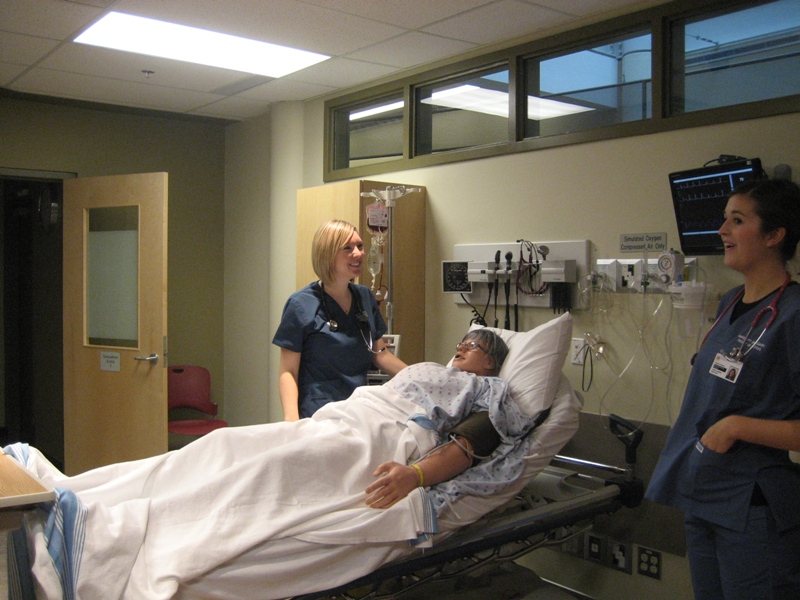
Last year, I once coincidently visited the alike simulation rooms for undergraduate nursing students, which were then located in the professional building at the U of C (See the right picture). The settings I saw in those rooms were fabulously similar as what Vicente described in his book. My eyes were cheated by the dummy lying on the bed in the simulated ward. I took it for granted that “she” should be a real patient until I was close to the bed then I realized how incredible it was. I only thought this kind of simulation was for students’ health care skills practice, but I had never considered it as one of the functionalities to improve team collaboration capability.

How many times have you noticed and complained that the more people work on the same thing, the worse result it gets. Just as Norman (2005) mentioned that “the more people that check on something, the less carefully each person performs the task.” (p145) Not only Vicente but Norman emphasize the great role of CRM on decreasing the problems that raised in team collaboration, though their elaborations are a little bit different. Both of their thoughts are based on human factors—crew members’ psychology and characteristic, more specifically, the CRM system’s target users’ characteristics.

Users’ characteristics—these “softer” factors are more likely to be ignored by designers, but interestingly, they are also the invisible criteria to evaluate how the design or product is, sometimes, it indirectly results in whether the thing assisted by the design succeed or not. Both Norman and Vicente have examined a lot about how effective Human-tech systems benefit us. That is why user’s characteristics, as a very important human factor, we should usually keep it in mind when creating and developing our design.

Once again, Vicente’s (2006) Chapter 6 deepens my understanding on the connotation of user-centered design. No matter how sophisticated it is, designers should try to help people “stay on the same page” by design (p180), furthermore, to satisfy our human or societal needs by tailoring the design of the system to fit human realities (p163).  
                                                                                                      

Sunday, October 24, 2010

Reading Response 4


The aim of interaction design….in essence, it is about developing interactive products that are easy, effective, and enjoyable to use-from the users' perspective.
                                                  ---------Preece et al. (2002)  Chapter1

The usability goals and user experience goals that are summarized by Preece and the co-authors are so incisive. They remind me of my own enjoyable and unsatisfied user experience as well.

My example of well-designed one: aeroplane’s online purchase experience

I once used my aeroplane points to order something online. Say, something like a gift card--Costco gold star membership card. After logging in the system, what I do is just showed in the flowchart below.


Making a purchase on the website of Aeroplane.com, the users could just click one button then be led to the next step clearly. Users can go back to the “category menu” at any time if they want to terminate the ongoing task and begin to make a new purchase from the very beginning. It is not confusing at all. I once successfully ordered two gift cards from it and received them in around one week. I felt so comfortable and convenient to use it. Below is my evaluation on the aeroplane online purchase system.
Effectiveness--The interface is capable of allowing me to carry out the purchase work efficiently, access the information I need, window-shopping the goods I want to buy and order them easily.
Efficiency—The interface lets me use single button or key presses step by step to conduct the whole order process.
Safety—The system prevents me from making serious errors. If I do make an error or if I change my mind and want to remove the item from the cart, it permits me to recover easily.
Utility--The system provides an appropriate set of functions that enables me to carry out all the purchase tasks, including keeping all my order history, all the receipts.
Learnability--The system is so easy to learn to use. What I only do a lot is spending time on making decision which items I really want to buy. For the system per se, it applies “ten- minute rule”.
Memorability--Believe it or not, I don’t have to remember how to use it. Just log in the websites and click on the buttons one by one. The only failure circumstance I could imagine is I was an illiterate.

My dissatisfied  experience on weebly page editing
WEEBLY is now being used as one of the optional tools for creating personal portfolio. How many of you have come across the same problems as I did? Did you notice that when editing paragraphs or texts, there are no font options on the page features? (See the below figure ).

If you hope the texts look like more aesthetical with various fonts and sizes, you would find out that you have no other choices but just follow the default fonts and sizes provided by the system. What I usually do is to edit the text in a WORD file aforehand, which was recommended by my friends. As WORD provides us with the functions of choosing different fonts and sizes when editing, I feel comfortable to use it to edit texts. But, it is not convenient if I edit the text in WORD first, then cut and paste it on the weebly pages. It seems to be a redundant step, but it is indeed in need. Actually, the system or the interface does not indicate us what to do if we want to customize the fonts and sizes in the editing page, we have to figure out other ways for makeup by ourselves. In addition, when you use it more and more, you might find that there are no sufficient functional tools for editing text with the comparison with WORD, such as no buttons for color choices. At this point, personally, weebly page does not have very good utility. It is not easy to try to edit a customized text on it. In addition, it does not provide the Preview function before publishing the weebly. Only after publishing could the editor knows how it looks like as what other visitors see. Then the editor has to return to the “log in” and to edit pages once again. It is somewhat not very efficient.

As a user, we are more likely to hold critical thoughts on various designs, both in positive and negative. We hope the design we are interacting with looks like in the way that we expected. If so, we will be delighted, otherwise, anger will be aroused.  As Norman (2005) pointed out that if the design itself is elegant, easy to use, we would praise it, or, we would blame the product. Another problem I am thinking about is how difficult it is to meet every user’s needs. Given the different using habits for different users, how will you objectively evaluate a product or a design from the feedbacks of the users? Take PC and Mac for example, I was recommended by dozens of friends that Mac’s interaction design is so neat. However, for me, I got used to the interfaces of PC and was very familiar with them. I still remember my frustration in using Mac at the first time. Thus, could I say Mac’s design is bad? Absolutely, I could not.

Saturday, October 16, 2010

Reading Response3---Optimizing the User Experience


“Web sites should be designed to facilitate and encourage efficient and effective human-computer interactions.”
      -----Research-Based Web Design & Usability Guidelines Chapter 2
When recalling my first days accessing to the internet about 10 years ago, I have never imagined that internet would become one important part in my life as what it is currently like. 

I am not a net-worm at all, but, I have to admit that, the interactions with PC and the internet seem to be my every day’s task, even only 10 minutes per day for emails, or ramble browse. Therefore, I am inclined to comment on various website unconsciously, sometimes positively, sometimes critically.

I totally agree with the author, “Web sites should be designed to facilitate and encourage efficient and effective human-computer interactions”. This kind of philosophy not only fits for the websites design, but for all designs.
I still remember the frustration when I developed my first Blog three years ago, I spend a whole bunch of time on trying to figure out how to add a gadget, how to upload a video, how to format the order of the pages, etc.  Although there were indeed some help or hints out there, I still needed time to make sense of them. Yeah, it sounds so easy today, however, for the beginning user of that website, I complained a lot about the usability, why it was designed like that?

Even today, more or less, when personalizing or creating something new on the web, you might notice that you still spend much time on technology issues on a certain website. It is so tricky that you might wish what if it’s easier than that. Anyways, we can see the efforts on the improvement for the website design. Not perfect, but much better than before. It pushes me to consider that how could I apply this philosophy to my group project? Please wait and see. When the draft is completed in the couple of few days, your comments and advice are very welcome.


Sunday, October 10, 2010

Thanksgiving Day in Canada

Thanksgiving Day in Canada has been a holiday on the second Monday of October since 1957. It is a chance for people to give thanks for a good harvest and other fortunes in the past year.

What do people do?                    

Many people have a day off work on the second Monday of October. They often use the three-day Thanksgiving weekend to visit family or friends who live far away, or to receive them in their own homes. Many people also prepare a special meal to eat at some point during the long weekend. Traditionally, this included roast turkey and seasonal produce, such as pumpkin, corn ears and pecan nuts. Now, the meal may consist of other foods, particularly if the family is of non-European descent.
The Thanksgiving weekend is also a popular time to take a short autumn vacation. This may be the last chance in a while for some people to use cottages or holiday homes before winter sets in. Other popular activities include: outdoor breaks to admire the spectacular colors of the Canadian autumn; hiking; and fishing. Fans of the teams in the Canadian Football League may spend part of the weekend watching the Thanksgiving Day Classic matches.

Public life

Thanksgiving Day is national public holiday in Canada. Many people have the day off work and all schools and post offices are closed. Many stores and other businesses and organizations are also closed. Public transport services may run to a reduced timetable or may not run at all.
Whilst Thanksgiving Day is holiday at a national level, it is not considered among the list of paid public holidays in New Brunswick under New Brunswick's Employment Standards Act.

Background

The native peoples of the Americas held ceremonies and festivals to celebrate the completion and bounty of the harvest long before European explorers and settlers arrived in what is now Canada. Early European thanksgivings were held to give thanks for some special fortune. An early example is the ceremony the explorer Martin Frobisher held in 1578 after he had survived the long journey in his quest to find a northern passage from Europe to Asia.
Many thanksgivings were held following noteworthy events during the 18th century. Refugees fleeing the civil war in the United States brought the custom of an annual thanksgiving festival to Canada. From 1879, Thanksgiving Day was held every year but the date varied and there was a special theme each year. The theme was the "Blessings of an abundant harvest" for many years. However, Queen Victoria's golden and diamond jubilees and King Edward VII's coronation formed the theme in later years.
From the end of the First World War until 1930, both Armistice Day and Thanksgiving Day were celebrated on the Monday closest to November 11, the anniversary of the official end of hostilities in World War I. In 1931, Armistice Day was renamed Remembrance Day and Thanksgiving Day was moved to a Monday in October. Since 1957, Thanksgiving Day has always been held on the second Monday in October.

Symbols

Thanksgiving Day in Canada is linked to the European tradition of harvest festivals. A common image seen at this time of year is a cornucopia, or horn, filled with seasonal fruit and vegetables. This represents the "Horn of Plenty", which was a symbol of bounty and plenty in ancient Greece. Turkeys, pumpkins, ears of corn and large displays of food are also used to symbolize Thanksgiving Day.

Resource from http://www.timeanddate.com/holidays/canada/thanksgiving-day

Happy Thanksgiving Day!